Tips on How to Teach a One Off Art Class
Outline and Sequence Summary In nearly cases, I like to teach the art lesson parts in the following order:
- Talk nigh the lesson for days or weeks - good ideas grow over time. Consider using questions that brand students curious and inspired. Encourage some individual ideas and approaches.
- Distribute supplies (avoid disruptions afterward)
- Review something that nosotros studied recently and introduce today'due south work. Using questions during the review lets students know that you look things to exist remembered and used over again.
- Practice what is new before students are asked to be creative with information technology. Students that have easily-on do prior to the project are apt to be more confident and artistic than those that have no idea what they are doing. Hands-on practice and questions can replace many instructor demos and examples that could dampen individual thinking, imagination, and creativity.
- Present master consignment - motivate more than than ane manner. Some ways include seeing, touching, tasting, hearing, smelling, games, practicing a process, competitive idea teams, collaborative projects, drama, dance, poetry experimentation, and adventitious serial, and so on.
- Student fourth dimension on task - oftentimes motivational open questions are used to help enrich, personalize, and focus ideas during this time. If things are not going well, stop everything and refocus the class. If things are going well, it is good to back and allow inventiveness to flow.
- Critique time - students can learn critique approaches that are both affirmative and discovery based that encourage learning without turning off or discouraging the participants.
- Endings and connections (discuss related art history and art in their lives) - review what was learned and how they learned. How we larn in studio fine art is frequently quite different than in other classes.
Setup and foreshadow upcoming sessions to activate thinking, sketching, journaling, subconscious thinking, and ideas.
The society in which things are done tells a lot near the teacher's philosophy of educational activity.

Table of Contents - click to jump to a topic
Apply the browser Back button to render hither
- pre-lesson foreshadowing
- distribute supplies
- review
- introduce
- practice materials and processes - subject field ideas - composition - style - observation
- motivation
- primary assignment
- time on task
- impulsiveness
- self doubters
- how to help
- endings
- connections
- mail service script
- outline (brief summary)
- who are the learners?
- why are y'all doing it?
- Which are virtually relevant to the lesson you are planning?
Skillful art lessons demand some difficulty to exist challenging, but need to exist easy enough to avoid too much frustration. Art skills are things like: observational drawing, ability to make clay practise what you lot want it to, power to brand tools and materials do what you desire, and the ability to actively utilize the imagination. Will your lesson exist piece of cake plenty so they are not discouraged? Volition the students exist challenged enough to keep their interest? Skills are learned by practicing. The best lessons are those that include practice grooming together with interest builders that motivate self initiated skill practice.
Imaginative thinking may not be idea of as a skill, simply information technology is a more bones skill than virtually art skills. Art teachers and writing teachers are in good positions to aid students retain, practice, and develop their powers of imagination. Imagination makes us human being, yet many schoolhouse assignments seem to be designed to discourage imagination. Every art projection needs to be at least partially assessed on the basis of its effect on the students' attitude toward, and ability to use, their skills of imagination. To often school extinguishes a child's divergent thinking and imaginative spark considering then much of school work is centered around learning the right respond. In fine art the kid can continue to believe that there are frequently many answers and that limits are oftentimes very artificial. Our imaginative and speculating ability is one of the basic skills that gives us the human spark. Teaching should ignite it rather than extinguish information technology.
2. Their art globe awareness:
Good art lessons review previous art knowledge. What artist's work tin can you refer to and expect students to know what yous are talking about? What historical examples are familiar? What examples from other cultures are familiar to your students?
to Teaching the Lesson to Top of Folio
3. Fine art knowledge/vocabulary:What new art terms exercise your students know, need to review past regular usage, and need to learn past your introduction with this lesson? What design principles do they know or need to acquire? How good are they at analyzing the way art furnishings viewers?
4. Attitude and motivation:
How much enthusiasm do students show for learning new skills, for routine skill practice, for new concepts, for learning the strategies that artists apply? Most students desire to do well. The chance to master something or at to the lowest degree encounter that they are improving, has a very positive effect on attitude and motivation. Some students take the mistaken idea that they cannot exercise well in art because they are not talented. Ability is generally the issue of effective practice. The art teachers job is to brand the difficult stuff easy enough to avoid besides much frustration, and to make the easy stuff challenging enough not to be slow. It is our job to know how art skills can exist practiced in ways that produce noticeable improvements in mastery. The recognition of improved mastery is i of the strongest motivations in art classes. This is a reason to have critiques and exhibitions of student piece of work.
What do your students know about the purposes of art in the world and in their lives? When students feel that what they are doing has a purpose beyond themselves, they are much more apt to be inspired to work hard to exercise well. Some of the many purposes of art can be reviewed as they relate to each lesson.
Motivation is generally strongest when students feel ownership in their ideas. This means that have to have a say in some of import choices made. When it is their choice, they are more apt to work hard because they are more apt to care about information technology. The most bored students I have seen are those that are working on an assignment that was clearly divers, simply information technology had very little room for personal ideas, very little perceived reason for what they were doing, and no idea about what they were learning by doing the work. They were slowly working to effort to become a passing marking.
Daniel Pink writes virtually motivation for workers in the business world. (Pink, 2009) The studio art class is a work culture of learning. Students learn by working on fine art projects. Pink says that intrinsic motivation for employees is based on worker autonomy, the run a risk for mastery, and having a purpose beyond the self. These are more of import than the pay charge per unit. In school these are more of import than grades. Does each art lesson include autonomy, mastery, and purpose? More on Motivation (below)
Teaching the Lesson to Top of Page
five. Art developmental level: Practice your students brand typical pictures, sculptures, and so on for their age? How many are more than avant-garde and how many are less avant-garde than expected for their age? How might this be addressed in this lesson? Grading is not based on what is known at the end, only based on what is learned from outset to end. Learning is based on what changes, not on what remains the same. Is it fair to give a meliorate grade to one that already knew it before the lesson and made very trivial advocacy? Or, should the best grades go to students who did not know it, but used the projection to learn new things and build new knowledge? If we can match the difficulty to the developmental level, we are more than apt to claiming without undue frustration.
- PLAN BACKWARDS. First South ummarize the specific art skills to be developed, the specific art knowledge to learn, and the attitudes to be fostered. These are the goals and objectives of the lesson (or unit). Skillful teachers often write the final exam commencement. Some call it backward planning. As we write this, we begin to imagine ideas about how these things can be learned. Even when no actual exam is planned, we practise the aforementioned thing. We identify what we want to happen to the pupil as a upshot of the lesson, the unit, or the year.
- Some lessons might concentrate more than on skill edifice, others may exist designed to encourage imagination and creativity, and some may emphasize learning the design principles and art elements (structure of fine art). Some lessons may primarily teach students approaches to style. Every lesson can end with some art globe and/or real world examples that review and build on the frame of reference provided by the lesson. In fact, i of best means for a teacher to go a good lesson or unit idea is to take a great work of fine art and deconstruct the creative process and strategies used by the creative person(s) that created the piece of work. This process yields an untold variety of ways to approach inventiveness and the materialization of ideas in visual art. Also meet opposite engineering.
- HINT - Post the list of goals and the creative strategies learned in the hall or in the display case with the display of the completed work. It helps other teachers, parents, and other students understand the dynamics of learning in the art.
to Teaching the Lesson to Summit of Folio
P lan of Action
T EACHING THE A RT L ESSON (or unit of measurement)
Please notation the sequence of these activities
Marvin Bartel - 1999, 2001 updated Sept. 2010
An Instance Lesson with all the parts is at this link.
- foreshadow the lesson
- distribute supplies
- review
- introduce
- practice materials and processes - discipline ideas - composition - mode - ascertainment
- motivation
- main assignment
- time on task
- impulsiveness
- self doubters
- how to help
- endings
- connections
- dismissal with purpose
- post script
- outline (cursory summary)
- who are the learners?
PRE-LESSON FORESHADOWING
Generally, it is better to avert surprising students with something they have not prepared for. The mind is an astonishing and powerful imagination auto. Creative ideas abound over time in the mind of the artist. It happens when we sleep, when nosotros eat, when nosotros watch TV, when nosotros talk to friends, when we fantasize, and so on. In studies of the encephalon, brain imaging shows that our hippocampus becomes agile when we are sleeping and when nosotros are not thinking nigh anything. Brain imaging shows actively on its own without our awareness. (Buckner, 2010) It imagines hereafter scenarios. Just as foreshadowing in a novel stimulates our imagination to foresee several exciting scenarios, art lesson foreshadowing gets students to imagine and anticipate, imagining their own ideas. On the other hand, ideas are not apt to hitting usa if nosotros have not yet focused on an artistic problem. Fine art teachers help students learn this skill past intentionally foreshadowing the side by side assignments and asking questions that prime the hippocampuses of the students. Students are asked to proceed a periodical of ideas that come to them when they are non thinking virtually the assignment.
What are some ways yous tin can foreshadow an fine art lesson? List some earlier you lot read the examples I give you in the next paragraph. Run across how many scenarios to foreshadow an art lesson your mind can imagine. If whatsoever of your ideas are different than the ones I listing in the next paragraph, that is just perfect. You lot have been outstandingly creative, but like you want your students to be artistic.
Okay, here are my ideas. See if there are any y'all want to add to your list. See if you thought of things I missed.
1) Along the top of the whiteboard in front of the room, the instructor makes a practice of posing a question that foreshadows a futurity fine art project.
ii) The teacher gives a sketchbook assignment that will provide ideas to use for time to come artworks. Can they guess what the assignment will be? What practice they wish it would be?
3) Students have cleaned upwardly and are waiting during the last one minute before the bell rings. The instructor asks them three questions and tells the class that these questions are related to the content of an consignment that is two weeks in the future.
four) The class is told that some of the homework for art is to keep a journal of notes about fine art ideas to do in art class. They are told that these ideas pop up anytime, and we need to jot them downwardly immediately.
5) The teacher takes time once a week to inquire students to share their unexpected 'pop up' ideas with the rest of the class.
half-dozen) Art inspiration comes from ascertainment, from experience, and from imagination. Moving betwixt these three sources help students minds remain flexible and and creative in their thinking.
If I missed 1 that you similar, transport it to me in an email (please include the spider web address or title of this folio).
I do not evidence examples of what I think they should do. To do and then, might consequence in imitation and a loss of appreciation for their own ideas. Peak of Page
| Also encounter Instruction Inventiveness The Chat Game The Secrets of Generating Fine art Ideas |
|---|
Top of Folio
one. ART SUPPLIES
Begin by having the class get settled with equally many working materials at their places as possible. This is done first to avoid the need for interruptions, commotion, and moving about once they are concentrating on the tasks at paw.
Many art teachers develop an orderly routine where students are expected to option upward what is needed as they enter the room earlier they go to their seats. If they expect to see a list posted or a sheet of paper on their table, they tin get things as they come up into the room. Some teachers assign tasks to sure students to bring supplies in order to limit mob movements. Some teachers withhold a unproblematic item in order to forbid students from starting before they have the motivation, focus, and instructions for the lesson. Other teachers provide written instructions for the first learning action so no exact instructions are needed while the instructor takes omnipresence, etc.
2. OPENING WARM UP
At this point some teachers institute a beginning ritual or warm-up. It focuses attending and tunes in to art. A few minutes of tranquility profile cartoon could serve as a routine warm-up and provide a take chances to practice an fine art skill. The teacher has a time to take omnipresence while students are on job. Some teachers have a box in the center of each work area with "Today's Objects" to practice drawing for the first few minutes as students settle down for form. Instructions are on the board or on the tables.
to Teaching the Lesson to Top of Folio
3. REVIEW and IntroduceA brusk review session is always appropriate at the beginning of the session. Ask students questions almost the central concepts and fine art vocabulary learned in a recent lesson. See if they tin can think recently studied concepts and help them understand how the ideas and skills will help them with this lesson.
4. LESSON INTRODUCTION
Briefly innovate the goals and issues of this lesson. Focus their thinking then that ideas have a take a chance to emerge during their preparation fourth dimension. Wait to give the detailed instructions until they are ready to work on the main lesson project.
There are skillful reasons to avoid showing examples of what the students are supposed to produce. For the reasons for this run across the listing of Nine Classroom Creativity Killers. Numbers 1, five, 8, and 9 speak straight to the reasons examples are non shown at the outset of an fine art lesson. Art History examples are shown near the stop of the lesson.
to Instruction the Lesson to Top of Page
5a. Preparation for m aterials usedTo quote a kindergarten child, "You can't never know how to do information technology before you lot always did it before." Students need to know how the materials and procedure piece of work in club to be creative with their interpretations of the content and design of their work. If it is a new procedure, it is only fair to allow and look them have a preliminary do session.
This office of the lesson might accept some time to "play around" with materials to meet what emerges by accident. Limit the fourth dimension for this. As soon as students cease to be involved in a search, move to a structured activity. I may exist useful at this fourth dimension to ask students to share their discoveries.
Example: The class is about to do a project where the medium will be transparent watercolors over a crayon limerick. Give each child five small pieces of paper and a few minutes in which to exam out this combination of materials allowing any sequence and any colour combinations on several small pieces of paper.
Present some carefully planned step-by-step instructions on the procedure. This is generally not a teacher demonstration, just hands-on participatory learning. Every student follows forth using art materials. This part of the lesson is not art, it is art skill or craft carefully presented by the teacher. The fine art immediately follows when the students are in charge of their own ideas and work while doing the main part of the consignment.
Example: The class is nearly to work with B6 cartoon pencils. These take soft graphite which allows for very bold dark black. Before using these pencils for drawing, have them brand the following lines about v inches long.
The teacher can ask, "Why do yous retrieve artists try to use some lines that are very dark, some very light, and some that are medium?" Unless students actively think about why they are doing things, they frequently forget to utilise what they are learning. When they start in that location artwork, they may however revert to pervious habits unless they are reminded with this "why" question again while they are working. When an art lesson begins to change habits of thinking, the students take away benefits that are good for their whole lives. Thinking about using a varied line character to achieve compositional dynamics may not sound like a big bargain, just it is an example of how every habitual way of working needs to be opened to new alternatives.
Beingness open to new alternatives is also true of our teaching methods. I retrieve a student teacher who had carefully observed how an fine art instructor was making many suggestions whenever a student asked for advice. It might have been better to be using questions or coaching students to experiment and learn to detect ideas for themselves. When I commencement observed her during student teaching, she too was making many suggestions. In our conference, I merely asked her if she remembered her observation the semester before. The next time I observed her, she remembered to use questions that encouraged her students to think more for themselves and become less dependent on her ideas.
to Pedagogy the Lesson to Top of Page
If possible, do non do a demonstration for students to watch. Its usually more effective to have them each actively practise a small-scale sample of the procedure themselves. Teacher demonstrations might be used if information technology would be too dangerous or besides complex to explicate in a step-by-step style while they all do information technology. When a demonstration is the only way I know to introduce a procedure, I try to follow it immediately with preliminary skill do before requiring any artwork to be produced with a new process.
5b. PREPARATION for t opic and southward ubject one thousand atter used
Nearly every art project includes subject matter. If the limerick is to be nonobjective, yous would skip to the next section, 5c. Preparation for compositional choices. Many teachers utilize topic motivation related to student interests, experiences, and concerns. Consider pupil development. Younger children are more egocentric and respond to "I" and "My" topics while older unproblematic children are quite interested in group identity topics and activities.
Sometimes teachers feel that it is more creative to allow students to have complete freedom to determine on any bailiwick matter. This tin present several bug. If the teachers says, "Do whatsoever you want for subject area matter," nearly students merely exercise whatever was easy and successful in the past. This lassie faire approach also implies that content is immaterial and unimportant. I might say, exercise what interests you, just endeavour something that you have not tried recently. Or, I might say, if you are repeating something, there has to be something changed so that after yous terminate, yous can compare it and acquire which works better.
Art lessons demand to help students learn ways to come up upward with meaningful and important content for their work. How can we look buying and motivation if the content is trivialized?
All fine art content comes from 3 sources: Observation, Memory, and/or Imagination. Lessons in observation are of import for the student'southward skill germination. Run across this link for a list of helpful means to help children larn observation skills. This Beginning Rituals folio describes careful ascertainment practice. This link discusses the human need to give aesthetic social club to our world. Top of Page
Retentivity is rich if it comes from rich experience. We retrieve what we find. When a child is fascinated and absorbed in an experience, information technology will be a pleasance to retrieve and express it. Teachers and others tin encourage marvel and awareness. Teachers, parents, and others can brand a point to ask many awareness building questions before, during, and after field trips and like activities. "Why practise you recall the giraffe has such a long neck?" "What shape (color) are the spots?" "Are some a dissimilar shape?" Some on-site sketching can be done. In the grade it tin exist developed into a larger drawing, painting, collage, diorama, and and then on. Students should be told in accelerate of the field trip that information technology will be the ground for artwork. This heightens awareness, attentiveness, and observations while on the outing.
Imagination gives united states of america amazing power. It is what allows usa to speculate virtually the futurity. It even allows u.s. to imagine what others recall of united states of america and how our actions might effect others. It allows us to think of alternative ways to human action. Art, creative writing, story telling, pretend play, drama, songs, etc. allow u.s.a. to exercise and develop our powers of imagination.
We need to increase the number of ways we teach the development of new ideas for fine art piece of work. Here are a few ways used by fine art teachers and artists to aid decide on content for an art project. These tin be used for ascertainment, retentivity, and/or imagination. We can encourage our students to practice these methods.
Acme of Page
Art lessons need to help students learn means to utilize the visual elements and principles of design to achieve the effects they desire to express in their work. Good blueprint generally seeks unity, harmony, and good integration of diverse visual furnishings. On the other mitt, it needs strong interest, emphasis, repetition, variation, move, emotion, and expressive content.
Consider special motivational activities to enrich their frame of reference for creative media work projects. These might be sensory exercises to make them more aware of texture, tone, hue, size, depth, intensity or another visual quality being learned.
Preliminary sketching and planning on split up paper are an splendid way for students to prepare for the chief project. For many lessons it is appropriate to require some preliminary planning. It is also a run a risk to assist them learn about quality by helping them acquire ways to discern their best ideas and the best ways to adapt their compositions.
5c. Grooming for stylistic approaches
Art lessons can help students larn ways to understand and develop style in their piece of work. This may seem difficult to do without showing examples of artists' work. However, there are many examples of individual style in other areas of our students' lives that they already sympathize. They know nigh style in music, in clothing, in dining, in hair, in handwriting, in cars, and then on. All these areas have are large categories as well as individual variations. We do non develop a personal style though copy piece of work or fifty-fifty past mimicking somebody else's style.
Most mature artists autumn into i of four large categories, simply also have a very individual recognizable style within the larger category. Most fine art styles autumn nether realism (naturalism), expressionism, formalism (including minimalism), or surrealism (fantastic).
Students frequently experiment with several styles. Ideally, we desire students who tin experimentally develop original styles rather than students that mimic or copy established styles. Since it may take years and many works before an artist tin exist expected to accept a mature distinctive style, students are encouraged to experiment with fashion, looking for effective ways to accomplish results. In the following experiments, every educatee is probable to see individual manner emerge.
Preliminary experiments directed to fashion might include:
- Listening to curt sections of several very dissimilar styles of music. Students can do 30 second mark making sessions in response to contrasting music sounds and rhythms.
- Using a dark marker, each student signs their name beyond the newspaper. Compare them.
- Making a serial of descriptive lines beyond the paper such equally, "calm and nervous" "waltzing and stumbling" "running and swimming".
- Filling textures into pre drawn boxes. Do non allow images or subjects. Have the textures represent noises that can non be identified so that each student will take to listen to the texture of the racket. Periodically, during these experiments, the instructor points out that every person is finding a unique way of doing this. Every person eventually, with lots of experimentation and practice, develops their own "aesthetic opinion" and their own "signature way". Not bad artists are not smashing because they learned how to re-create or mimic another style. Smashing artists are great because of what they contribute.
5d. PREPARATION for ascertainment to Education the Lesson to Pinnacle of Page
| 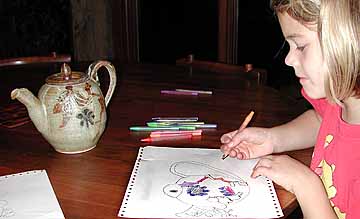 |
I said, "When I draw something new, I similar to sit and look at all the shapes and lines before I start. When I await at this office (pointing to the top) of the handle, I notice that the acme hither is more round, when I wait at this part down here I notice that information technology is almost similar a straight line. I also like to look at how big the different parts are, and compare the size of the handle and the spout, or the size of the handle and the belly of the pot. I like to imagine each line before I draw it."
I do non draw whatsoever examples because I practise non want children to observe my drawing when they demand to larn to observe the bailiwick. I do talk about drawing experiences. I know that children fail to learn considering the are afraid to fail. Therefore, I talked virtually all the mistakes I brand when I draw something. I said, "Usually, I draw a line, merely after I depict it, I can notice that information technology should have been a little different shape or a little different size, just I don't erase correct away. I just go out information technology and I endeavour another line. When I am finished, I might get dorsum and erase some mistakes. My mistakes are proficient because I learn to encounter better from them - they are my practice lines. Whenever we try a new thing nosotros expect to make some mistakes, but with exercise nosotros get meliorate at information technology."
She was noticeably pleased with her ain achievement. In this one cartoon of the teapot she moved from the "schematic" stage of geometric simplification to the "dawning realism" stage in her cartoon. She now has a bones foundation for learning to notice. She can now draw anything she wants to (with like observation and practise). With enough of this kind of teaching and practice in the first grade, she can exist spared the crisis of conviction that many third grade children experience.
The problem with many drawing education books is that they prescribe shortcuts and formulas that requite success without any bodily observation. Without developing much power, they replace the motivation to really learn. Observation practise and many more than links on teaching drawing can be constitute here. Teachers who teach cartoon past cartoon for the children are not directing their minds to right learning task. The task is not to replicate a drawing. If the learning task is to imagine and create a cartoon past observing the existent world, the kid learns to draw anything - not only the specific thing being taught. Top of Page
half dozen. Define and Begin THE Master Project
G ive or review the detailed explanation of the assignment. Be sure instructions are understood, and they feel comfortable about your expectations. Empower them to create. Define limits to encourage problem solving, only allow private ownership of ideas and piece of work. Explain the primary points that you plan to evaluate. This link has a rubric for grading artwork. Some teachers make a poster with their assessment points. Some apply a handout.
Be specially sensitive to questions as they starting time start to piece of work. If there are more than i or two questions, terminate and analyze things for the whole class. If there are deadening starters, brand sure they understand, simply allow time to recollect, to experiment, to plan, and time to await at more one selection.
to Teaching the Lesson to Top of Folio
7. MAINTAIN CONCENTRATIONWhile they are working, stay tuned to the class and be thinking of ways to keep them on chore. Art teachers sense when a class is getting off track. Students begin to discuss their social lives and other topics that have nada to exercise with the trouble at mitt.
A series of focused merely open questions tin can bring the students back on task. Practiced open questions bring richness and content into their work. "Does the dog accept a special aroma? What is the role of the domestic dog that is the darkest? ... the lightest? How much larger does the dog's body seem than the dog'southward head?" Questions help passive knowledge becomes active knowledge and gets it included in the artwork. Open up questions (those with many possible answers) stimulate the imagination.
If they are working direct from observation of the subject (the canis familiaris is in the room), they will be encouraged to make better observations if the teacher goes over to the canis familiaris and asks well-nigh specific aspects of the subject. Ask, "How does height and length compare?" while placing hands almost the subject to show height and width. Focused but open questions generally upshot in much richer student work. They surprise themselves with how well they can do if they have really fabricated careful observations. This works with an individual or with the whole group. If several students are floundering at once, it may be more efficient to call the whole class to attention and accept time to refocus.
What questions might have been asked related to the lawn tennis picture shown at the top of this page? Superlative of Folio
7a. IMPULSIVE QUICK WORKERS
Some students are impulsive and rush to finish without giving enough attending to important aspects of the piece of work. You should encourage them to develop more circuitous products. "This role looks really interesting. I wonder what you could do to brand this other role as interesting." "I run across some nice depth effects here by the fashion the colors work. Hither's some empty infinite. What could happen in this area that adds interest?" A teacher tin can help these students go more thoughtful and deliberate past raising issues to call up about in their piece of work. Eventually, the pupil'south habits volition meliorate if the teacher is insistent and consequent. Stay positive, but keep asking questions. I notice that many students brainstorm to imitate this and they brainstorm to ask themselves similar questions every bit they work. They learn how to learn.
Summit of Page
MOTIVATION - verbal - I resist making suggestions - I utilize open questions to raise bug for them to consider in their work. Their greatest need is thinking practice. I practice not want to have this away from them past providing answers. I endeavor to utilize focused questions. Eventually they learn to conceptualize the type of questions needed to produce meliorate fine art, and they volition need less hand property. Expert teaching empowers them by helping them learn the kind of questions artists utilize to improve their own work. When I am asked for a suggestion, I first ask what the student has been thinking near. Often the educatee already has an thought or two, but was not confident to try it.
MOTIVATION - multi sensory - There are many kinds of motivation. I have used unseen (hidden) sound making devices as motivation for texture. When when working from food, flowers, plants, smell and sometimes taste is incorporated into the preliminary experience. Studies bear witness that students who examine something by touch create richer artwork than those who merely work from visual observation.
MOTIVATION - animals - Live animals elicit instinctive attention. Every child pays attending to an animal moving around. Field trips to farms, zoos, etc. are great venues for cartoon and/or for asking lots of observation questions.
I avert showing examples every bit motivation because fake is besides easy. It shortcuts original thinking. to: Top of Page
7b. DELIBERATE AND Cocky-DOUBTING STUDENTS
Other students are handicapped by being very slow and deliberate. They may be perfectionists considering they are agape to make a mistake. Reassure them. They need confidence to experiment with expressive approaches. They need to appreciate the learning that comes from mistakes and to come across how "happy accidents" happen. Sour lemons make bully lemonade with the right additions. Empower them by building their conviction. Don't encourage these students to start over unless they have a better idea they are anxious to try.
Practice non be tempted to tell them that quality doesn't affair and don't say, "I'm not an artist either." Say, "I frequently make mistakes when I am learning a new thing, but I like my mistakes considering they help me larn by pointing out what I demand to practice more. Often I don't erase my mistakes until I finish so that I tin larn from them. When I finish, I even leave some mistakes because they add motion or extra excitement and magic to the piece of work. Sometimes my mistakes are the all-time office. Sometimes they give me an thought for something better to try." Encourage them by pointing out that some things are only learned by practice and the more we exercise the better it volition get.
Observe the best role of what they accept done and tell them why you lot remember so. Don't utilize praise that is empty or general, but praise together with specific information so they tin can learn from it. Top of Page
A serious mishap tin justify a start over. Deliberate and self-doubting perfectionists may specially benefit from assignments that brainstorm with "intentional accidents" that are changed into artwork past the private's artistic efforts. 8. PRECAUTIONS and HOW TO Assistance WHEN IT IS TOO Difficult
Never do any of the piece of work for the students. Do not describe on their papers. There are other ways to assist without taking abroad ownership and empowerment. Expert instruction is making the hard stuff easier and making the like shooting fish in a barrel stuff harder, but a good teacher never does the work and never solves the trouble for the student. If you must draw to illustrate a point, do it on your own newspaper - never on theirs.
If they are having trouble drawing or modeling from observation, go over to the thing being observed and enquire in detail what they run across. If more is needed, explain in detail what yous run into. If they are working from imagination or retention, use detailed questions to aid them remember and value their own past experiences. Encourage the give-and-take challenging instead of as well hard. Top of Page
Avoid assignments for which they accept no reasonable frame of reference. Amish children should not have to make fine art about Tv characters. As yous heed to student conversations, larn their real interests. Base topics on their interests, experiences, and what can exist observed in or near the classroom. Click hither to review listing making and other ways to generate ideas.When a student is afraid to attempt something, requite them extra paper on which to make several experiments or to practise on. Artists oft practice experiments, practice, and inquiry earlier they feel prepare to endeavour information technology in their actual work. Of form artists work according to many unlike styles and strategies and some of them want all the expressiveness of mistakes and false starts to remain as evidence of the artistic procedure. For an abstract expressionist (action painter) much of the meaning and feeling of the piece of work would be lost if they pre planned or practiced it, just for most art styles it is mutual to practice or make sketches alee of the actual work. Height of Page
9. MEANINGFUL ENDINGS - making c riticism p leasant
Discus the finished work as a fashion to affirm pupil efforts and review the concepts learned. Be fair and inclusive. Critiques that are affirmative and discovery based help produce a slap-up studio art learning culture. Everybody can respond the question, "What practice you notice starting time?" , simply not everybody tin explicate the reasons they notice something it get-go in a composition. Accept them practice the analysis and interpretation of piece of work. Require comments that speculate about why we notice something start. Assist them learn to clarify the effects of color, size, brightness, uniqueness, subject matter, and then on.
Interpretation refers the the meanings and feelings seen. We can enquire for ideas for titles. We can hash out the visual reasons for meanings and feelings observed. The one who created the work may want to verbalize near this, but I try to delay this until others have a chance to respond. We need to learn well-nigh the richness of meanings and feelings that are possible in a group setting.
Never allow judgmental comments similar, "I don't run into why anybody would utilize that color for . . . " When commenting on a perceived weakness allow just neutral questions and then the student creative person may be asked to explain rather than defend a choice. "Tin nosotros talk a bit about the effects that this colour is producing? Who tin give us an idea?" Frame the questions in not-judgmental terms. Use questions to raise awareness, not to declare mistakes. Art is a search. Critique makes discoveries.
A llow time to include each work or adapt a fair system that includes everybody within a series of lessons. Emphasize the positive and use questions to get discussion going. Take advantage of learning opportunities. Some situations may work better if this is done in smaller groups. This might brainstorm when the first 4 to half-dozen students complete a project. Each time another four to vi students cease, some other discussion group is formed. Written forms can also be used at times. Peak of Folio
Assistance students larn how to question, how to describe, how to clarify, and encourage them to speculate nearly possible meanings (interpretations) and feelings in each other's work. Nosotros have to help them learn to be conscientious viewers and critics that sympathise with each other and their work, ideas and feelings. One of the principal purposes of the critique is to find, recognize, and exploit discoveries in the piece of work. The secondary purpose is to cultivate a positive civilization and better human relationship skills. Studio artwork is a search for art. If we skip the critique, we may be missing half the learning. ten. CLOSING CONNECTIONS
Relating this project to their world and the fine art world.
Your lesson planning strategy frequently starts by thinking about the closing portion of the lesson. What creative activities volition best build a frame of reference for this experience? What do you want students to take with them from the experience? Just as a beginning ritual tin help focus and center the class's attention, an ending ritual gives meaning and relevance which is then vital to learning. This link is a beginning ritual that includes an ending connection from art history.
This is also a good time to enquire questions about ways they will now detect things differently as they exit the art room considering of the lesson they have worked on today. Will information technology alter the fashion they encounter colors? What will exist the new things they notice in their everyday experiences?
Helps in finding artists on the spider web and using their images
How to spell and pronounce artists names To get back here, employ your Back push button (top left on your browser). This is an offsite link to ArtLex, Copyright � 1996-2002 Michael Delahunt. Once we have the correct spelling of an artist's proper noun, we tin find examples by using a search engine like google.com.
Using copyrighted artwork images - when y'all become to this link, scroll down in the left frame and click on copyright . To get back hither, utilise your Dorsum button (elevation left on your browser). This site gives caption of what is legally permitted in the classroom. This is an offsite link to ArtLex, Copyright � 1996-2002 Michael Delahunt. Top of Folio
xi. DISMISSAL WITH PURPOSE
We take a take a chance to better student minds and thinking habits by doing at least one of these things at dismissal time.
- Review today's main points and vocabulary.
- Talk about lessons being planned for the time to come.
- Invite ideas for future fine art lessons.
- Ask open art questions to call back virtually.
- Tell or show an art joke.
- Offer to show them a gymnastics trick if they are quieter adjacent time.
- Students are assigned things to look at and expect for in their lives.
- Students are sent away with their hidden minds actively creating imaginary solutions to art problems anticipated in the future.
- Students are sent away formulating new fine art bug to work on.
- Art teachers wait students to come to the side by side session with new periodical entrees and new sketches of what they have seen and imagined.
Artists never go away from the homework of the middle and the mind. Nosotros dream art both at nighttime and in our daydreams. We sketch and journal these rich ideas and so that when we finally go to enter the studio, the ideas force themselves onto the canvass or into the clay. Fine art teachers sympathise this and notice means to inculcate their students with creative ways of seeing and thinking most all of life.
to Pedagogy the Lesson to Top of Page
You may exist thinking, "This is too much to do in one art lesson." An Example Lesson with all the parts is at this link.
When students are meaningfully engaged in learning, to continue projects from week to week or from session to session is not a waste matter of time. The brain that can retrieve of ideas if we foreshadow the questions before the lesson, can also imagine new ideas and ameliorate alternatives to endeavour. The fourth dimension between work sessions allows the hippocampus (the hidden mind) to think of new ideas. Artists often continue their work from session to session. When students are doing things virtually themselves, when children discover purpose, see mastery, and feel autonomy in artwork, they often have a much longer attention span for artwork than for other studies. Studies show that nosotros can employ artwork as a way to lengthen attention span (Posner, 2010). Likewise oftentimes art has been a waste material of fourth dimension because it was only taught as an "action for the hands" resulting in products for decoration at best, only without learning about art equally a discipline and without ownership of the ideas by those who fabricated it. Some children enjoy this, but others find it boring busy work.
If possible, make time to teach the whole lesson by continuing i lesson over several sessions. Recollect of it as a unit if that helps. This is a much better option than leaving out the meaningful parts. You might repeat the opening rituals to start each session, and include a short review before each session. Top of Folio
If overall time is a real problem, consider scheduling fewer lessons rather than skipping meaningful learning opportunities. The length of time we spend on each subject doesn't always make sense. It may simply be a result of tradition rather than meaningful research.The all-time way to build conviction is to practice the activities and projects yourself earlier pedagogy the lesson. Information technology is easy to find out what materials are needed when you do information technology yourself. I accept oftentimes made important discoveries while doing this. Make a list of the materials as y'all use them.
While working, make notes about essential questions to inquire to go students thinking and go on them focused while they are working. Doing it is a nifty way to be sure everything in planned. Refrain from showing this work until students accept had a risk to do their own thinking.
What do nosotros learn from planning and educational activity this lesson?
Teaching is exercise. Every experience is a gamble become better. Brand notes of successes and shortcomings. As in whatever skill, nosotros seek to brand the best of our strengths and attempt to remedy our weaknesses. If I ask a teaching chore candidate about her/his mistakes, I would hope for a response that lists many mistakes, simply also many things improved because of beingness able to recognize teaching mistakes. If a teachers says, "I've had a few bad results, but information technology was not my fault. The students were just having a bad day." I would hesitate to hire that teacher.
Adjacent Steps: Top of Page2. Make yourself notes to repeat the best parts of the lesson next time you teach it.
3. Make a list of ideas to try to improve whatsoever part of the lesson or experience that seemed less than ideal. Information technology is ofttimes helpful to discuss these bug with successful teachers with similar experiences. Successful teachers cultivate friends who are positive, creative, and helpful to each other. Meridian of Page
Outline
(the short version)
- distribute supplies (avoid disruptions later on)
- review and innovate today's work
- practice whatever may be new before they are asked to exist creative with information technology
- nowadays main assignment, motivate, utilize employ open up questions
- student fourth dimension on task - refocus if needed - apply open questions
- talk over the outcomes to review what is learned and what was discovered
- endings and connections (hash out related art history and art in their lives)
| Other Art Teaching Links Art Ed HOME folio Abode-bartelart.com Harvard |
Credits Pink, D. H. (2009) Bulldoze: The Surprising Truth About What Motivates The states. Penguin Grouping, New York. Posner, 1000. I. &Patoine B. (2010) "How Arts Training Improves Attention and Noesis" The Dana Foundation website. http://world wide web.dana.org/news/cerebrum/particular.aspx?id=23206 Author NOTES: Much of what is offered on my spider web site is motivated by the desire to assist students acquire to recall for themselves. Few educational goals are more important than this. Many authors have influenced my ideas and helped me think about thinking, expressing emotions and ideas, and how this is learned. Many of my ideas almost teaching art accept been hammered out through trial and error over many years of instruction art and during supervision of apprentice art teachers. Some ideas are in response to the DBEA (Discipline Based Art Education) trend to increase the showing of examples (or "doing enquiry" of other artists) prior to media work. I question this. I look for ways to inspire more authentic artistic and imaginative thinking. Having said this, I believe it may exist an unintended trend considering the goals of DBEA are non dependent on showing examples before the creative piece of work. I am certainly supportive of DBEA's goals of making fine art education a more serious and more comprehensive endeavor. Many of the ideas that have guided my thinking throughout my art pedagogy years were hatched or inspired in the classes of Dr. Phil Rueschhoff at the University of Kansas during my graduate work there. We learned every bit much equally possible about creativity and the attributes of highly creative individuals. Rueshhoff studied with Viktor Lowenfeld, author of Creative and Mental Growth. Lowenfeld was frequently discussed. Rueschhoff's ideas are recorded in a text notwithstanding bachelor in some libraries and in the used book market. It was Rueschoff that helped united states understand the value of showing the exemplar at the cease of the lesson instead of at the beginning of the lesson. Rueschhoff, P. H., Swartz, M. Eastward. Teaching Art in the Unproblematic Schoolhouse: Enhancing Visual Perception. 1969. The Ronald Press Company, New York, 339 pgs. Superlative of Page Detect: © 1999, 2001, 2005 Marvin Bartel. Those who wish to copy or publish whatsoever part of this electronically or otherwise must get permission to practise then. Teachers may make one copy for their own personal use. Links from other sites are okay. Contact the Writer at bartelart.com/mb.html Check this online book of eight drawing lessons |
Source: https://www.goshen.edu/art/ed/artlsn.html
0 Response to "Tips on How to Teach a One Off Art Class"
Postar um comentário