according to the mayflower compact what was the purpose of the voyage Answer sheet
The Mayflower Compact
If they looked behind them, there was the mighty bounding main which they had passed…to split up them from all the civil parts of the world.
-- William Bradford
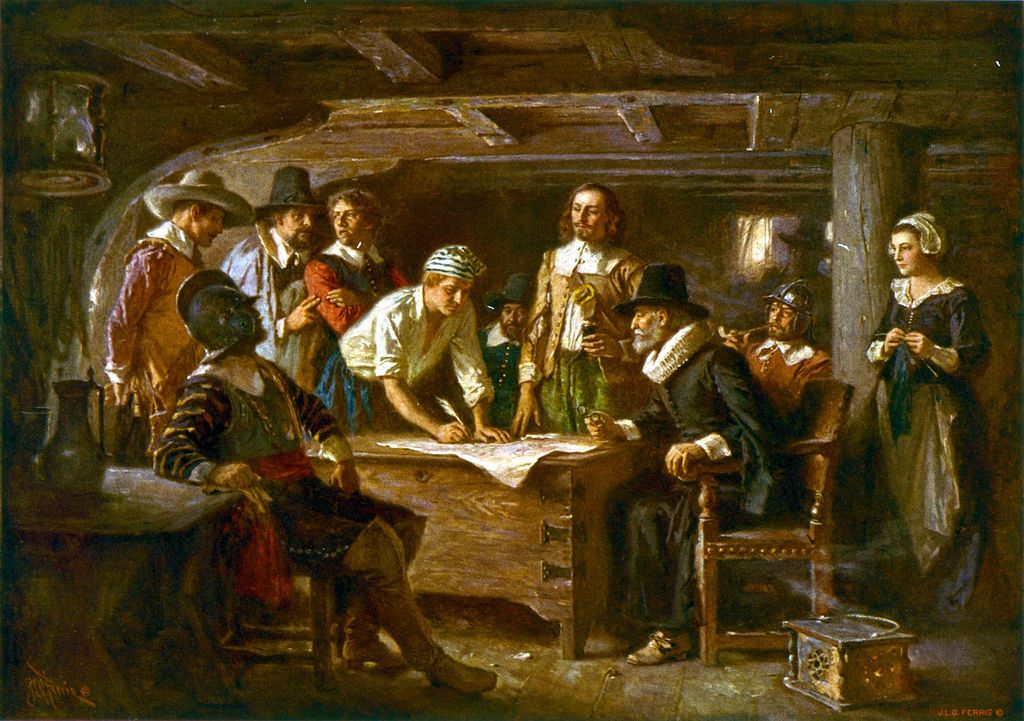
Signing the Mayflower Compact 1620, a painting past Jean Leon Gerome Ferris 1899 (Wikimedia Eatables)
The 102 passengers on the Mayflower were divided into two groups. Merely 41 of them were Pilgrims--religious dissenters chosen Separatists, who had fled England for Holland. Now they sought a new life in America where they could practice their religion in the mode they chose. The residuum of the passengers, called "strangers" by the Pilgrims, included merchants, craftsmen, skilled workers and indentured servants, and several young orphans. All were common people. Nearly one-3rd of them were children.
The Pilgrims had organized the voyage. William Brewster and the other Pilgrim leaders had secured the right to settle on state claimed by the Virginia Visitor near the mouth of the Hudson River. To raise money for the voyage the Pilgrims signed a contract with a group of London stockholders. In return the stockholders would share in the profits of the planned colony. The Pilgrims had rounded up the "strangers" to increase the chances of success for their enterprise.
The three,000-mile voyage beyond the Atlantic lasted more than 2 months. When they finally sighted land on Nov 9, 1620, the captain of the Mayflower knew right away that they were at Cape Cod, far north of their destination. The captain headed the Mayflower due south, just dangerous sand confined and heavy seas forced them to plough dorsum. The Mayflower finally dropped ballast in a harbor at the tip of Greatcoat Cod. Rather than chancing more than days at sea, the Pilgrims decided to land.
Almost immediately, an statement broke out. According to William Bradford (who later wrote an account of the Pilgrims' experiences) several "strangers" made "discontented and mutinous speeches." They obviously argued that, since the Greatcoat Cod area was exterior the jurisdiction of the Virginia Visitor, its rules and regulations no longer applied. The troublemakers threatened to do as they pleased "for none had power to control them," wrote William Bradford. Three yard miles from home, a real crisis faced the colonists even before they stepped ashore.
The Mayflower Meaty
Imagine the situation: over 100 people, cutting off from any government, with a rebellion brewing. Merely staunch conclusion would help the Pilgrims country and institute their colony. If they didn't work as a group, they could all die in the wilderness.
The Pilgrim leaders realized that they needed a temporary government potency. Dorsum home, such authorisation came from the king. Isolated as they were in America, it could only come from the people themselves. Aboard the Mayflower, by necessity, the Pilgrims and "Strangers" made a written agreement or meaty among themselves.
The Mayflower Compact was probably composed past William Brewster, who had a university education, and was signed by nearly all the developed male colonists, including two of the indentured servants. The format of the Mayflower Meaty is very similar to the written agreements used by the Pilgrims to establish their Separatist churches in England and Holland. Under these agreements the male developed members of each church building decided how to worship God. They also elected their own ministers and other church officers. This pattern of church cocky-authorities served every bit a model for political cocky-government in the Mayflower Compact.
The colonists had no intention of declaring their independence from England when they signed the Mayflower Compact. In the opening line of the Compact, both Pilgrims and "Strangers" refer to themselves as "loyal subjects" of King James. The rest of the Mayflower Meaty is very brusque. It simply bound the signers into a "Civil Body Politic" for the purpose of passing "just and equal Laws . . . for the general good of the Colony." Merely those few words expressed the idea of self-government for the outset time in the New World.
Cocky-Regime Takes Root
Immediately afterwards agreeing to the Mayflower Compact, the signers elected John Carver (ane of the Pilgrim leaders) as governor of their colony. They chosen it Plymouth Plantation. When Governor Carver died in less than a year, William Bradford, age 31, replaced him. Each year thereafter the "Civil Body Politic," consisting of all adult males except indentured servants, assembled to elect the governor and a modest number of administration. Bradford was re-elected thirty times between 1621 and 1656.
In the early on years Governor Bradford pretty much decided how the colony should exist run. Few objected to his one-homo rule. As the colony's population grew due to immigration, several new towns came into being. The roving and increasingly scattered population plant information technology difficult to attend the General Court, as the governing meetings at Plymouth came to be chosen. By 1639, deputies were sent to represent each boondocks at the other General Court sessions. Non simply self-rule, just representative regime had taken root on American soil.
The English Magna Carta, written more than than 400 years before the Mayflower Compact, established the principle of the rule of police. In England this even so mostly meant the king's law. The Mayflower Compact continued the thought of law made by the people. This idea lies at the heart of commonwealth.
From its crude get-go in Plymouth, self-government evolved into the town meetings of New England and larger local governments in colonial America. By the fourth dimension of the Ramble Convention, the Mayflower Meaty had been most forgotten, simply the powerful idea of cocky-government had non. Born out of necessity on the Mayflower, the Compact fabricated a pregnant contribution to the cosmos of a new democratic nation.
The complete text of the Mayflower Compact
For Discussion and Writing
1. What two groups comprised the passengers on the Mayflower? How were they dissimilar from each other? How similar?
2. What events forced the passengers on the Mayflower to write and sign the Mayflower Compact?
3. What facts in the article support the argument that the Pilgrims were democratic? What facts support the view that they were not autonomous?
4. What is the near important idea contained in the Mayflower Compact? What are some other ideas it contains?
For Further Reading
Bradford, William. Of Plymouth Plantation. Samuel Eliot Morison, ed. New York: Alfred A. Knopf, 1952.
Donovan, Frank R. The Mayflower Meaty. New York: Grosset & Dunlap, 1968.
A C T I V I T Y
Mayflower 2
The twelvemonth is 2120, and the American spaceship Mayflower 2 has landed on Mars, exactly 400 years after the start Mayflower reached the New Globe. Aboard the Mayflower Two are a team of scientists and a larger group of skilled workers.
The mission of this voyage is to construct a research base on Mars for scientific observations and experiments. Unfortunately, due to a malfunction, the Mayflower 2 crash-landed in an expanse outside that designated for U.S. exploration by a United nations treaty. This territory is not within the jurisdiction of any Globe nation.
Although the crash disabled the Mayflower II and its radio, all personnel equally well as the supplies and life support systems survived intact. The scientists and workers will be able to live in the Mayflower II and build structures outside the spacecraft. They look a rescue ship will be sent, but not for many months.
Shortly after the Mayflower 2 crashed, an argument broke out between the scientists and workers. The workers claimed that the whole purpose of the project had changed from scientific research to survival. Since the workers know how to build a survival base of operations, they tin take care of themselves. The workers also pointed out that because they are in an area of Mars outside the jurisdiction of the United States, they are not bound to obey the orders of the scientists (or whatsoever laws for that thing).
The scientists rejected these views, and argued that they had been put in charge of the project back on Earth and therefore should remain in control until the rescue transport arrives. They besides reminded the workers that their superior education and preparation every bit scientists make them the logical ones to lead the group in this alien environment.
After wrangling over these matters for a while, the scientists and the workers finally agreed to work out a written compact that would provide the ground for a authorities until the relief ship appears.
Procedure
1. Imagine your grade is the group of men and women stranded on Mars.
2. Divide the class into 2 groups:
- Scientists (about one-3rd)
- Workers (about 2-thirds).
3. Concord a meeting where you lot discuss and vote on an answer to each of the post-obit questions:
- Should at that place exist a single leader or a group of leaders?
- How should the leader or leaders be selected?
- Who should brand the laws?
- How should the lawmaker or lawmakers be selected?
- Should a police force exist established to enforce the laws? If so, how should the police force be selected?
- Should a judge or judges be selected to preside over trials? If so, how should the gauge or judges exist selected?
- What general rule should make up one's mind how piece of work is to be accomplished?
- What rights should anybody have?
4. Afterwards discussing and voting on answers to the questions, write upwards the results in a Mayflower II Meaty.
5. Take a final vote. Decide whether approval of the compact should crave unanimous agreement, a two-thirds majority or a unproblematic bulk. After voting on the Mayflower Ii Compact, all those agreeing should sign it.
6. Debrief past asking "What similarities and what differences do you come across betwixt the circumstances surrounding the signing of your Mayflower II Meaty and the circumstances surrounding the signing of the original Mayflower Meaty in 1620?"
© 2002, Constitutional Rights Foundation, 601 Due south Kinglsey Drive, Los Angeles, CA 90005, (213) 487-5590 Fax (213) 386-0459
Source: https://www.crf-usa.org/foundations-of-our-constitution/mayflower-compact.html
0 Response to "according to the mayflower compact what was the purpose of the voyage Answer sheet"
Postar um comentário